Fighting Weaponized Incompetence With Strategic Incompetence
Let’s womansplain it: weaponized incompetence is when a partner pretends to be bad at a task to avoid doing it. Social media is a graveyard of videos showing partners "accidentally" shrinking laundry or "forgetting" how the dishwasher works. If you want to stop being the default parent, it’s time for a countermove.
Consider Strategic Incompetence, and I’ll be honest, it’s psychological manipulation. It isn’t the healthiesttool, but in a relationship where one person is already using it to exploit the other’s labor, it becomes a survival tactic.
Why should you be the only one burdened with being the mature partner while your back breaks under the load? If the only way to get him to see the problem is to let the problem happen, then so be it.
What you can learn:
Specific reasons why your partner is feigning ignorance
How to stop doing everything for your partner
Setting boundaries with a lazy partner
Strategies for equal distribution of household labor
Why Does My Husband Act Like He Doesn’t Know How to Clean or Take Care of the Kids?
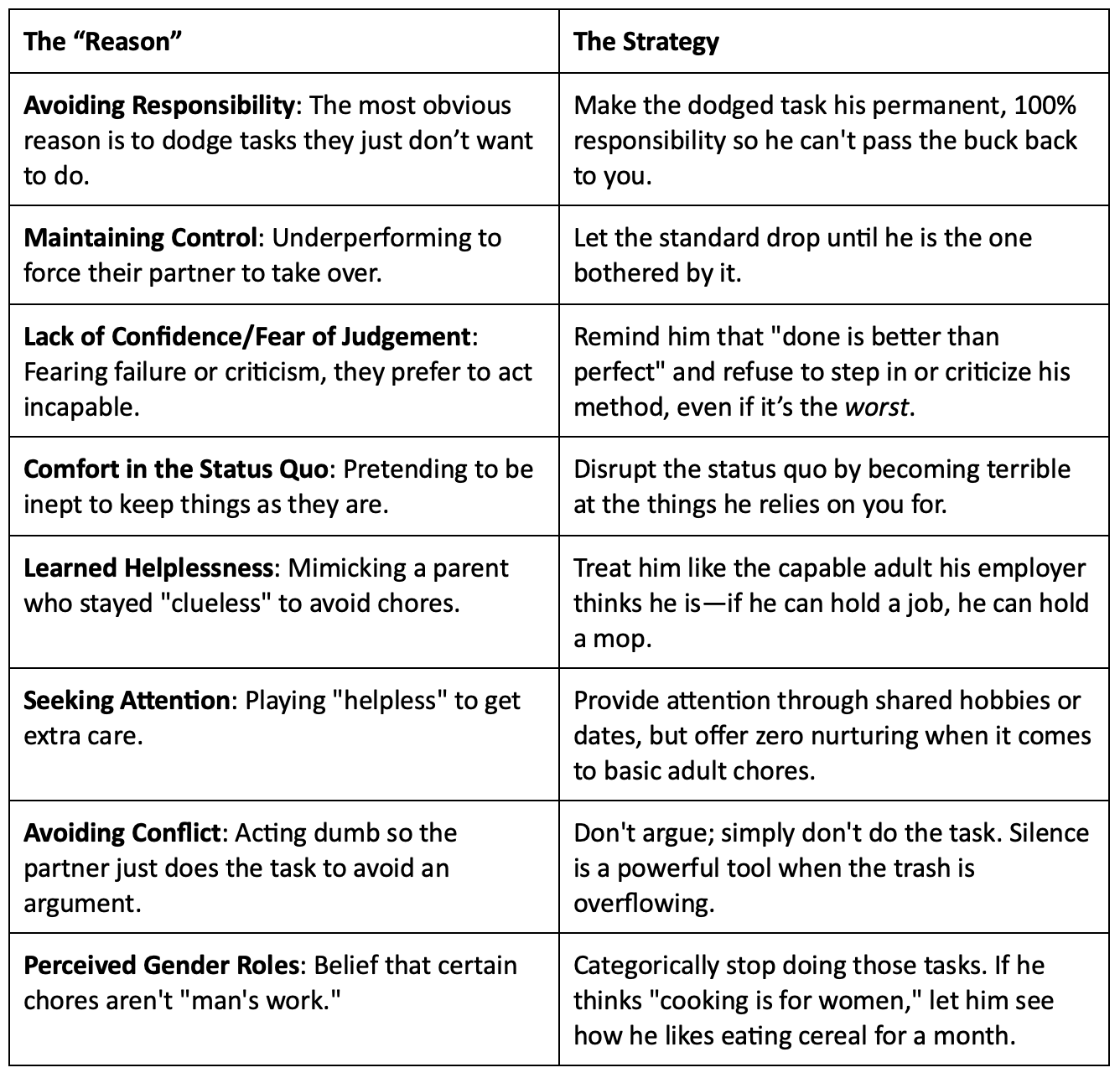
The invisible mental load is one way that modern men are failing their partners. The other is the actual physical effort of doing housework, childrearing, and even paying the bills. Weaponized incompetence is a way to get what they want. But understanding the specific reason why your partner fakes uselessness can help address the behavior. Here are some reasons and how to combat them:
How to Stop Doing Everything for Your Partner
If you’re going to use incompetence to reclaim your life, you have to do it right. You can’t look like you’re faking it. But you don’t necessarily have to act or lie when you’ve genuinely reached your limit.
1. Be Authentically Incompetent
To make this work, you have to find the tasks that truly drain you and lean into your genuine burnout. Don't say, "I don't know how to cook" after years of being the household chef. Say, "My brain literally cannot process a recipe right now. I am incapable of making a decision on dinner." When you are authentically overwhelmed, your "incompetence" isn't a lie—it's a boundary.
2. The 100/0 Rule
You cannot be half-incompetent. If you try to do a task 50/50, you are still responsible for the outcome. For strategic incompetence to work, the task must be completely off your list.
Bad: "I'll buy the groceries if you cook them." (You are still the manager).
Good: "I don't know what's in the pantry, I don't know the budget, and I don't have the grocery app. You are now the Food Person."
If you’re failing at having a 50/50 partnership, then maybe that doesn’t work for your relationship. Instead of trying to do half of everything, divide tasks into his and hers.
3. Let It Burn (Metaphorically)
This is the hardest part. If you step in to fix his mistake, you have failed.
If he does the laundry and the kids go to school in wrinkled, mismatched clothes? Let them.
If he's in charge of the kitchen and it’s covered in grease? Leave it.
If you’re the one always fixing the problem, he never experiences the consequences of the problem. He has to feel the friction of his own incompetence before he has any motivation to gain competence.
4 Tips For Setting Boundaries With a Lazy Partner
Feigning incompetence isn't your only move. Depending on the day or the task, you might find that a different approach—or a combination of several—works better to break the cycle.
The "I Trust You" Pivot - When he asks "How do I do [Task]?", don't answer. Say: "I know you're smart enough to figure it out." This affirms him while keeping the labor on his plate.
Highlight His "Natural" Talents - "You’re so much better at bathing the kids than I am; they actually listen to you!" This uses positive reinforcement to lock him into a recurring responsibility.
Drop the Standard - Accept that his way will be different (and probably worse at first). If you criticize the way he cleans, you’re just inviting him to say "Fine, then you do it."
The Hard Exit - Physically leave the house when a task needs to be done. You can't be asked how the vacuum works if you aren't there to hear the question.
Another option, one that was actually suggested to me by my doctor, is to try the Fair Play book and Fair Play Deck. I haven’t personally tried these options because I would need a spouse who would actually be willing to read, listen, and play. Hence, my use of psychological warfare.
My Real-Life Examples of Shifting the Mental Load and Rebalancing Chores
I’ve used a combination of all of these tactics to rebalance our household.
Strategic Incompetence
While I can cook, my husband is a professional. I reinforce how “terrible” I am at preparing food and selecting produce to ensure he handles all food-related tasks.
The “I Trust You” Pivot
Two years ago, I told my husband to clean the vacuum-mop water tank. His immediate response was, "How do I do that?"
Instead of explaining, I said with a wry smile, "I think you’re smart enough to figure it out." By refusing to be his search engine:
I acknowledged his intelligence (so he couldn't play dumb).
I protected my mental energy.
I made it clear that I am his partner, not his supervisor.
He has cleaned it ever since.
Highlight His "Natural" Talents
His “natural” talent is playing with our toddler outdoors. Since I have a "natural" aversion to the sun, he does what he does best while I stay indoors where it’s cleaner and quieter.
The Hard Exit
After our son’s first birthday, my husband shifted from parent to “helper.” I hit my limit and left for the night. I returned to a messy house and an angry spouse. I told him I was leaving the house and the money to him. He didn't believe I'd abandon our son. Holding my passport, I said, “I didn’t sign up to be a single mom.” If one night was inconvenient, seventeen years solo would be hell.